Published
How to Write a Resume Skills Section That Lands Interviews
A step-by-step guide to building a resume skills section that passes ATS scans, mirrors the job ad, and proves each skill with evidence from your work history.
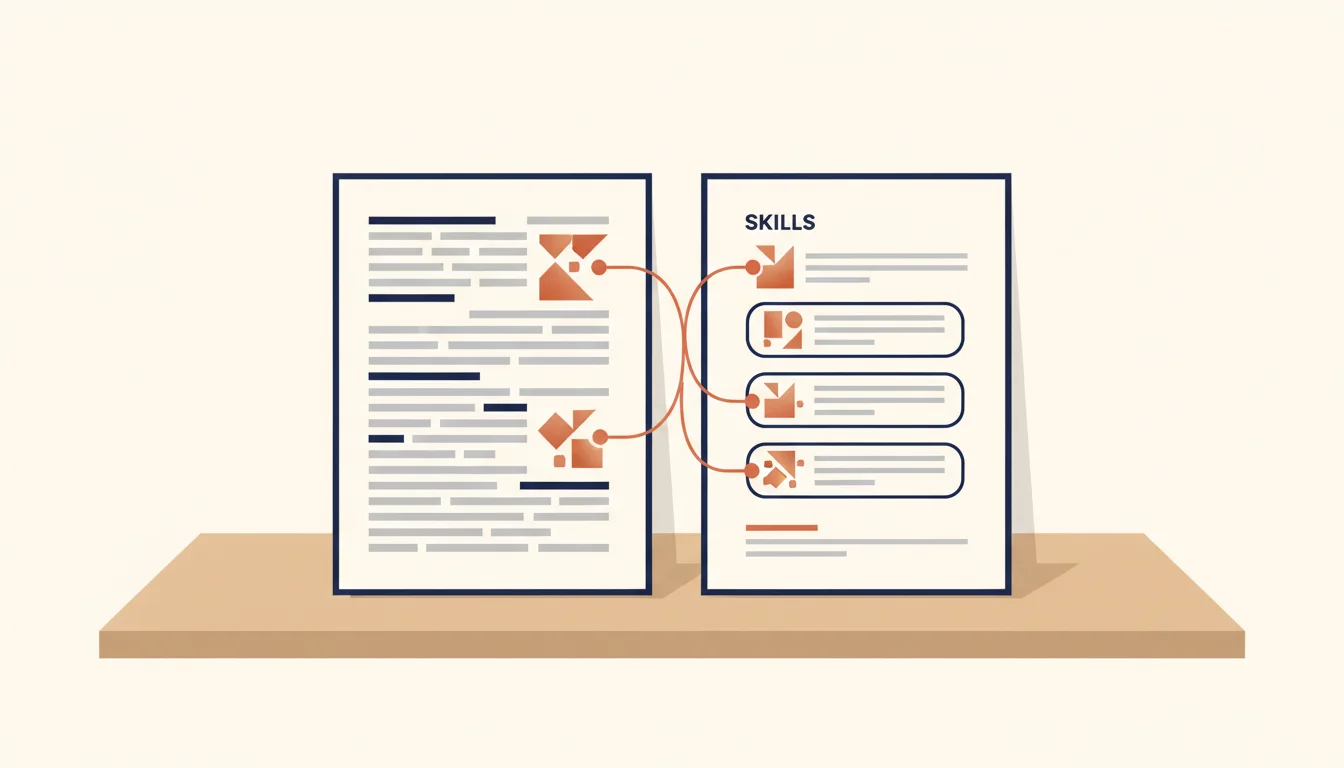
TL;DR: Lift 8–12 skills directly from the target job ad, group them into 2–3 named subcategories, and make sure every skill is backed by a concrete bullet in your work history. A generic list of "communication, teamwork, leadership" actively hurts you — it dilutes the real keywords the ATS scores. Pull up the job ad and rebuild the section in 20 minutes.
What a skills section is actually for
The section has two jobs, and neither involves self-expression. First, it feeds the applicant tracking system a structured block of keywords it can match against the job description. Second, it gives the recruiter — who spends 7.4 seconds on the initial scan — a fast answer to "does this person have the stack we asked for?"
Workday's parsing engine "extracts details from resumes, such as education, skills, and work history" and organizes them into structured profiles scored against the job description. In Jobscan's 2025 survey of 380+ recruiters, 76.4% said they start filtering candidates by skills — more than any other field. Skills aren't a sidebar; they're the filter.
This reframes what belongs there. "Communication, teamwork, leadership" does nothing for an ATS match, because the same three words sit on every other candidate's resume. You're not competing on whether you have those traits. You're competing on whether your resume contains the exact tools, methods, and domain terms the job ad named.
A skills section is a keyword-matching instrument, not a self-portrait. Every item should either appear in the job ad or be a provable adjacent skill you can defend in a 30-minute interview. Anything else is padding.
Step 1: Extract skills directly from the job description
Open the job ad in a document and highlight every noun phrase under "requirements," "qualifications," and "responsibilities." Look for tools ("Salesforce," "Figma," "Google Analytics 4"), methods ("A/B testing," "sprint planning," "cohort analysis"), and domain terms ("SOC 2 compliance," "B2B SaaS," "demand generation"). That's your source list.
Match the phrasing exactly. If the ad says "Google Analytics 4," don't write "web analytics tools." If it says "stakeholder management," don't substitute "people skills." Jobscan's 2025 State of the Job Search analyzed roughly one million applications and found resumes whose job title matched the listing had a 10.6x higher interview rate than those that didn't (Jobscan's own data — directional, not independently replicated) — the same effect holds for skill keywords. An ATS looking for "GA4" won't resolve "web analytics"; a recruiter skimming for "stakeholder management" won't stop on "interpersonal skills."
Target 8–12 skills. Fewer than six looks thin. More than 15 reads as padding, and the signal-to-noise ratio drops fast past item 12. Jobscan recommends a 75–80% match rate between your resume and the job description for a reasonable ATS pass rate; 8–12 well-chosen skills does most of that work.
One more rule on phrasing: include both the spelled-out version and the acronym when both appear in the field. "Search Engine Optimization (SEO)" beats either alone, because some parsers match strict strings and others normalize to canonical forms. If the ad uses only one, mirror it.
- 1
Copy the job ad
Paste the full posting into a document.
- 2
Highlight noun phrases
Mark every tool, method, and domain term under requirements and responsibilities.
- 3
Dedupe and trim
Remove duplicates and anything you cannot defend. Aim for 8–12.
- 4
Mirror the phrasing
Copy the ad's exact wording — tools, acronyms, and all.
For the full keyword-extraction process, see how to pull keywords from a job description.
Step 2: Group skills into named subcategories
A flat, comma-separated list of 12 skills reads as soup. Group them into 2–3 named subcategories — "Technical," "Tools," "Languages," "Methods" — based on how the job ad organizes its requirements. If the posting separates "must-have tech" from "nice-to-have methods," mirror that structure. It signals you read the ad.
Separate items with vertical pipes or bullets, not commas that blur into a paragraph. The difference matters for both the skim and the parse: a recruiter's eye catches discrete tokens faster than a wall of text, and some ATS parsers split on delimiters to populate structured fields.
| Layout | ATS parsing | Recruiter skim |
|---|---|---|
| Flat comma list | Parses, items may concatenate | Reads as a paragraph |
| Named subcategories, pipe-separated | Clean split into structured fields | Each line answers a question |
| Visual skill bars, star ratings | Often unreadable — parser sees an image | Self-rated scales read as overclaiming |
Skip progress bars, star ratings, and proficiency percentages. Jobscan's 2026 formatting guide explicitly flags "skill level bar graphs" as unreadable by most parsers. Recruiters distrust self-rated scales on top of that — "Python: 90%" tells an engineer nothing, because 90% by whose standard?

Subcategory names matter as much as the contents. "Core Skills" is lazy; "Data Tools" or "Backend Languages" is useful. Rename them for each application if the job ad uses specific terminology — "Design Systems" on a role that asks for design system experience is a small but real keyword win.
Step 3: Prove every skill in a work bullet
This is the rule every competitor article skips: every skill on your list should appear in at least one work bullet. If it doesn't, cut it.
The reason is simple. A recruiter cross-checks your skills against the story your experience tells. Listing "SQL" while describing three roles that never mention data is a contradiction — and contradictions get caught at the phone screen, not on the resume. ResumeLab's 2023 survey of U.S. workers found 15% admitted to lying in the skills section specifically. Hiring managers know this. They compensate by auditing, not by taking skills at face value.
The discipline: for every skill, write one sentence in your head about the last time you used it at work. If you can't, either the skill goes or you add a bullet that grounds it. Usually this means revising a work bullet to name the tool explicitly. A bullet that reads "Built a reporting pipeline to cut month-end close time by four days" becomes "Built a SQL reporting pipeline using Airflow and dbt to cut month-end close time by four days" — same achievement, three more provable skills.
Apply the rule in both directions. If a work bullet describes a skill you forgot to list, add it. Your experience and your skills section should be the same argument told at two resolutions.
Step 4: Cut the soft skills that everyone lists
"Communication," "teamwork," "leadership," and "problem-solving" are the four horsemen of the generic skills section. They sit on most resumes, which means they sit on every other candidate competing for the same role. As a differentiator, they do nothing. As ATS keywords, they barely move the needle — a parser matching "communication" against a job ad that mentions communication returns a hit thousands of other resumes also return.
Zety's 2024 study counted "teamwork and collaboration" used 51,309 times across their resume database. Jobscan's 2025 data shows 55% of job listings emphasize communication skills, so it's not that these skills don't matter — it's that listing them as a keyword wins you nothing, because the match is saturated.
Two rules to apply.
Keep a soft skill only if the job ad names it specifically. "Stakeholder management," "cross-functional collaboration," or "executive communication" are specific phrases a job ad might use. Mirror them verbatim. Generic "communication" is not that; cut it.
Move the rest into your work bullets where they can be demonstrated. "Led a six-person migration team across three time zones" proves leadership without claiming it. "Presented the quarterly roadmap to the board" proves executive communication without needing the phrase. Claims are cheap; evidence is expensive, which is exactly why it's persuasive.
The skills section is where you match the ad's hard requirements. The work experience section is where you prove the soft ones. Stop fighting that division.
Where to place the skills section on the page
Two placements make sense, depending on the argument your resume is making.
Below the summary, above work experience. Use this if the skills are your headline — technical roles, junior applicants with thin work history, or career changes where transferable skills matter more than job titles. The skills-first layout tells the recruiter "here's the stack; now let me prove it."
Below work experience, near the bottom. Use this for senior applicants where the career narrative is the selling point. A director with 15 years of experience doesn't open with "Python, SQL, and Excel" — the roles do the heavy lifting, and the skills section becomes a reference list for the ATS.
Never split into two skills sections ("Technical Skills" at the top, "Additional Skills" at the bottom). It fragments the keyword cluster the ATS is looking for, and it signals a resume that grew by accretion rather than editing.
For length trade-offs — whether adding a skills section pushes you from one to two pages — see how long a resume should be. For the bigger picture of matching every section to the job description, the ATS resume optimization guide covers the full pipeline.
Common mistakes to fix in 10 minutes
Open your current resume and run through this list.
"Microsoft Word" or "Email" as a skill. In 2026, both are assumed. Listing them signals padding.
"Expert" or "10+ years" next to a skill. Self-rated seniority triggers interview failures when the interviewer finds a gap. Drop the qualifier and let the work bullets do the vouching.
Skills you haven't used in five years. If the last time you wrote Ruby was 2019, it's not a current skill. Cut it or move it to a brief "Prior experience" note.
A skills section copied from a template. The default Indeed or Coursera template skills list is the same list every competitor ships with. Rebuild from the job ad every time.
Progress bars and star ratings. Workday, Greenhouse, and Taleo all score keywords that appear as text. A bar graphic is invisible to them, and it often swallows the skill label with it.
A list longer than 15 items. Recruiters read the first 8–10 and skim the rest. Everything past item 12 is noise that dilutes your strongest keywords.
Ready to rebuild? Upload your resume for a tailored rewrite — the skills section gets rebuilt against your target job ad automatically.
Should I include a skills section for creative roles?+
Yes — but name the tools, not the traits. 'Figma, Adobe After Effects, motion design' works; 'creative, innovative, visual' does not.
How many skills should I list?+
8–12. Fewer reads as thin; more reads as padding and dilutes your strongest keywords.
Do I need a skills section for a senior role?+
Yes, but place it below work experience. The ATS still reads it; the recruiter uses your titles and companies first.
Key takeaways
- Lift 8–12 skills directly from the target job ad; skills invented from your own memory won't match the ATS's keyword graph.
- Group skills into 2–3 named subcategories separated by pipes — never a single comma-separated paragraph, and never visual progress bars.
- Every skill on your list must appear in at least one work bullet. Unprovable claims get caught at the phone screen, where 15% of admitted skills-section lies originate.
- Cut generic soft skills like "communication" and "teamwork"; keep them only if the job ad names a specific phrase like "stakeholder management."
- Place skills above work experience for junior or career-changing resumes; below it for senior ones. Never split the section in two.