Published
CV Personal Statement Examples: What Works and What Fails
Six annotated CV personal statement examples — three that land interviews and three that get skimmed past. With the specific rewrites that fix them.
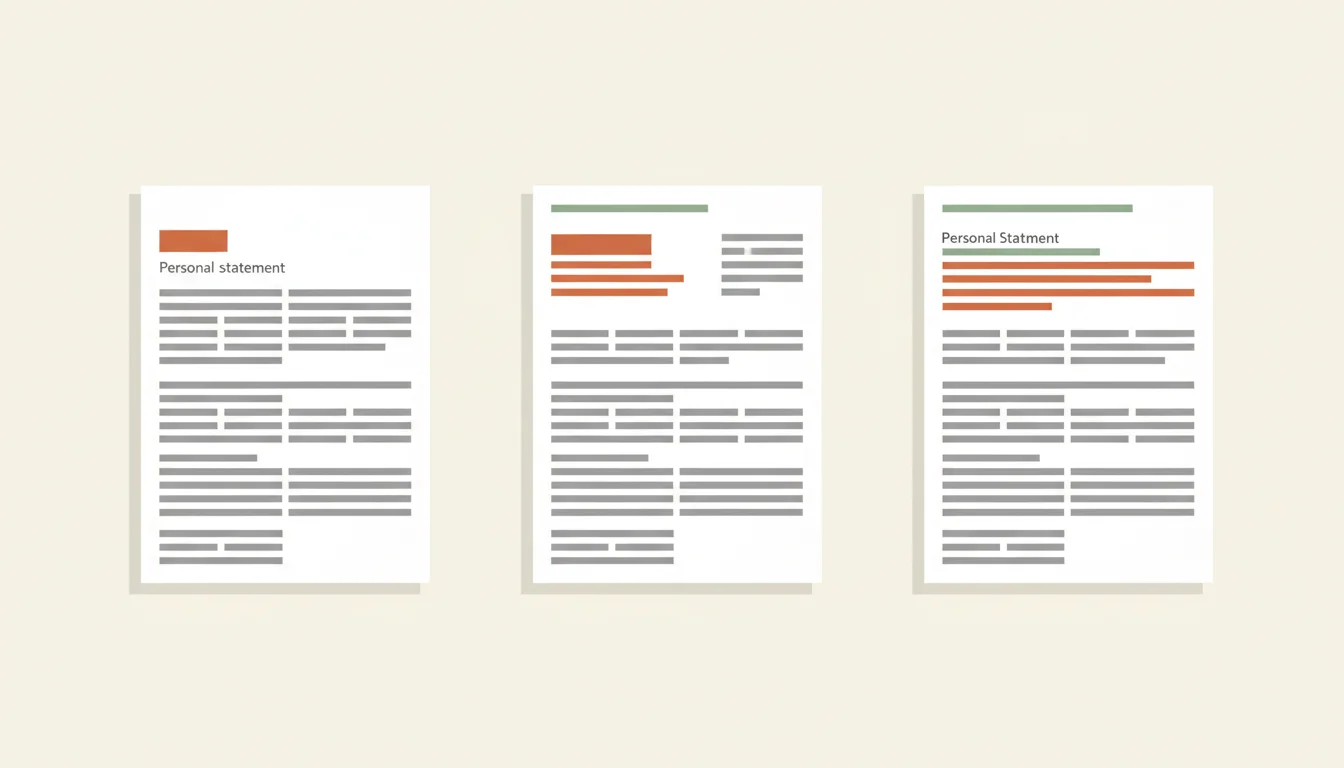
TL;DR: A good CV personal statement is three sentences: a role-fit claim, a quantified proof point, and a targeted intent. The statements that fail are stuffed with "motivated, passionate, hardworking" adjectives that carry no evidence. Rewrite yours using the three-sentence formula below, then check it against the six annotated examples that follow.
What a CV personal statement actually is (and what it isn't)
A CV personal statement is a 50–150 word paragraph sitting at the top of your CV, directly under your contact details. It functions as the argument the rest of the document supports — every job, every metric, every line of the work history exists to back up the claim you made at the top.
This is a UK and Irish convention, not a universal one. The US résumé equivalent is a "professional summary" in the same position, which tends to be more achievement-dense and less narrative. Prospects — the UK government-linked graduate careers service — defines it as "a concise paragraph or summary, which details what you can bring to a job or company."
Personal statement: A 50–150 word paragraph at the top of a UK or Irish CV that states who you are professionally, what evidence supports that, and what role you want next.
Three things a personal statement is not:
- It isn't a cover letter. The cover letter is a separate document that makes the case for one specific application. The personal statement lives on your CV and moves with it.
- It isn't a US-style objective. Objectives are out of fashion in both markets, and they frame the statement around what you want rather than what you offer.
- It isn't a bio. A bio describes the whole person; a personal statement describes the professional claim relevant to one role.
Why this matters: the 2018 Ladders eye-tracking study of 30 recruiters measured initial CV screening at 7.4 seconds. The sample is small and the methodology has been debated, but the direction of travel is well-documented: the recruiter spends seconds on first pass, not minutes. Your personal statement is often the first paragraph they read, and sometimes the only one.
The three-sentence formula that works
Three sentences. That's the whole structure. Every sentence has one job, and if any of them tries to do two jobs, the statement collapses into the adjective soup you're trying to avoid.
Sentence 1: The role-fit claim. Who you are professionally, stated in the language of the role you want. "Backend engineer" if they advertised a backend engineer. "Software developer" if they said software developer. This is the sentence the ATS and the human both read for keyword match — and Jobscan's guidance is to put the job title and three to five critical keywords near the top of your resume precisely because the top section carries disproportionate parsing weight.
Sentence 2: The quantified evidence. One specific proof point. A number, a named campaign, a named client, an outcome. "Delivered £3.2m new ARR in 2024" is evidence. "Led a successful marketing strategy" is not. If you cannot attach a specific to the claim, cut the claim and find one you can.
Sentence 3: The targeted intent. What you want next, named as a specific role or a specific kind of employer. "Seeking a senior product role at a seed-to-Series-B B2B SaaS company" is targeted. "Seeking a challenging role in a dynamic company" is not — and it's the most common failure mode in the examples the competitor blogs keep publishing as good.
The formula works because it forces you to cut the unearned adjectives. Every "motivated" has to be replaced with a thing you did. Every "excellent communicator" has to be replaced with a named audience and outcome. The resulting statement is shorter, specific, and carries evidence the recruiter can verify against the work history below it.
Three CV personal statement examples that work — with annotations
Here is the formula applied at three experience levels. Read each one twice: once for the argument, once for how the three sentences hand off to each other.
Graduate — applying for a junior backend engineer role:
Computer Science graduate (2:1, University of Manchester) with backend development experience in Python and Go from a third-year capstone project. Built and deployed a distributed job-scheduling service handling 4,200 tasks per minute on a three-node cluster, benchmarked against Celery and documented in a 28-page technical report. Seeking a graduate backend engineer role at a London-based fintech or infrastructure company.
The quantified evidence sentence does the work a graduate's missing job history can't do. "4,200 tasks per minute" and "three-node cluster" are specifics a hiring engineer can picture — and ask about in the interview.

Mid-career — marketing manager applying for a senior marketing manager role:
Marketing manager with 5 years' experience in B2B SaaS demand generation, specialising in paid acquisition and lifecycle campaigns. Led the 2024 "Onboard in 10" campaign at Acme Ltd, which cut free-trial-to-paid conversion time from 22 days to 9 and drove £860k in net-new ARR across the second half of the year. Looking for a senior marketing manager role at a Series-B SaaS company building its first dedicated growth team.
Sentence 2 names the campaign. It names the before-and-after metric. It names the revenue outcome. The recruiter now has three hooks to ask about in interview, and each hook is verifiable.
Senior — finance director applying for a CFO role:
Finance Director with 12 years across private-equity-backed industrials, currently leading a 14-person finance function at a £180m-revenue manufacturing business. Delivered £11m working-capital release over 18 months through supplier-payment-term renegotiation and inventory-cycle redesign, and led the £62m refinancing that reduced blended cost of debt from 7.1% to 5.4%. Targeting a CFO role at a private-equity-backed business between £100m and £400m revenue, ideally pre-exit.
The intent sentence names the company size, the ownership structure, and the stage. A CFO recruiter reading this knows within fifteen seconds whether the role on their desk is a fit.
Three CV personal statement examples that fail — and the fix for each
These are the failure patterns the competitor example-dumps still publish as acceptable. Each one is reconstructed from patterns that appear across dozens of templates — and each one has a specific rewrite.
Failure 1: The adjective stack.
I am a motivated, passionate, hardworking team player with excellent communication skills and a proven track record of success in fast-paced environments. I thrive under pressure and am always willing to go the extra mile.
Every adjective is unearned. "Motivated" — by what? "Proven track record" — of what, where? Prospects explicitly warns against "bland, empty statements like 'I work well independently and as part of a team'" — this failure mode is the reason that warning exists.
Rewrite: Operations analyst with 3 years' experience in logistics planning at a national retailer. Redesigned the store-replenishment forecasting model for a 240-store estate, reducing stock-outs by 18% and cutting £1.4m in excess inventory during the 2024 financial year. Seeking a senior operations analyst role at a retail or consumer-goods business with a multi-site footprint.
Failure 2: The biography.
I graduated from the University of Leeds in 2019 with a degree in Business Management. After university, I spent two years at a marketing agency before moving to my current role at an e-commerce company, where I have been for 18 months.
This is a timeline. Your work history section is also a timeline. You've just used 50 words to repeat information that appears in full below.
Rewrite: E-commerce merchandiser with 4 years' experience across agency and in-house roles, focused on conversion-rate optimisation for mid-market fashion retailers. Ran the A/B testing programme that lifted category-page conversion from 2.3% to 3.1% at Blackstone Apparel, adding an estimated £540k in annual revenue. Targeting a senior merchandiser role at a digital-first fashion or lifestyle brand.
Failure 3: The generic intent.
...seeking a challenging new role in a dynamic, forward-thinking company where I can use my skills and grow as a professional.
No sector. No role level. No team type. The recruiter cannot tell if this candidate is applying for their role or every role on LinkedIn.
Rewrite: ...targeting a senior product manager role at a B2B SaaS company in fintech or revenue operations, ideally on a team of three to six PMs with a mandate to launch new product lines.
| Failure mode | What it does wrong | What to replace it with |
|---|---|---|
| Adjective stack | No evidence behind any claim | Named campaigns, numbers, clients |
| Biography | Repeats the CV timeline | Lead with a role-fit claim |
| Generic intent | Names no target | Specific sector, stage, team type |
Personal statement examples for students and graduates
The "I have no experience" objection is the single biggest reason students default to the adjective stack. There is no way to write "delivered £3m in revenue" if you've never had a revenue-bearing job. The solution isn't to lower the bar on the evidence sentence — it's to broaden what counts as evidence.
Acceptable sources of quantified evidence for a student personal statement, in rough order of recruiter-trust:
- Internships and placements. Numbers from any real-world work count the same as numbers from a full-time role.
- Capstone projects, dissertations, or extended coursework. Name the project, the technical scope, and the measurable outcome. "Analysed 14,000 tweets using BERT sentiment classification, achieving 84% accuracy on a held-out test set" is evidence.
- Part-time work. Retail, hospitality, tutoring — every one of these produces measurable outcomes if you look. "Handled 140+ transactions per shift as a senior till operator" beats "excellent customer service skills" every time.
- Volunteering, society leadership, competitions. Treasurer of a society with a £12k budget. Team captain winning a national competition. Founding editor of a student publication with 8,000 monthly readers. All evidence.
- Degree classification or GPA. Lead with this only if it's strong — a first or a 2:1 from a named institution. A 2:2 is better not mentioned in the statement at all.
Student example — retail part-time job, applying for a graduate consulting role:
Economics graduate (2:1, University of Edinburgh) with client-facing experience from three years as a senior sales assistant at John Lewis. Built and ran the team rota-scheduling spreadsheet that cut weekend overtime by 14% across an 18-person department, and trained four new starters through their probation period. Seeking a graduate analyst role at a management consulting firm with a retail or consumer sector practice.
The retail job is the evidence. The consulting role is the target. The statement does not pretend the candidate has consulting experience; it argues that the transferable specifics are real.

The intent sentence for students applying broadly can name the industry rather than the job title — but it should still name something. "A graduate role in financial services" is acceptable; "a challenging graduate role" is not.
How long should a CV personal statement be?
50–150 words. That's the functional band. The sweet spot for most roles sits at 70–100 words — enough to complete the three-sentence formula without padding, short enough to read in one glance.
Reed's career advice page specifies "no more than 150 words (or about four to five lines on your CV)". Prospects agrees on the 150-word ceiling. Most UK careers services converge on the same band.
Measured in lines on the page: three to five lines of body text in a standard 10–11pt font. If your statement runs to six lines or more, something has gone wrong — usually a second evidence sentence that should have been cut or folded into the first.
Under 50 words and the statement reads as a placeholder. The recruiter registers that the paragraph exists but concludes it has nothing to say, which is worse than having no personal statement at all — you've used prime screen real estate and wasted it.
The length constraint matters because the personal statement is competing with the work history for attention. Every line you give the statement is a line the recruiter is not spending on the jobs that back it up. For the broader length question, see how long a CV should be.
How to tailor a personal statement per application without rewriting it from scratch
The last objection most candidates raise: "If I have to rewrite this every application, I won't apply to enough jobs." The answer is that you don't rewrite the whole thing. You rewrite one sentence and swap one keyword.
- 1
Lock sentences 1 and 2 for a role family
Write one base statement per role family you're applying to (e.g., 'senior product manager, B2B SaaS'). Sentences 1 and 2 — the claim and the evidence — stay roughly stable across every application in that family.
- 2
Rewrite sentence 3 per application
Name the specific company, team, or product area where possible. 'Targeting a senior PM role at Acme' is better than 'targeting a senior PM role'. If you don't know the team shape, name the stage and sector.
- 3
Swap one keyword in sentence 1 to match the job description
If the posting says 'software engineer' and your base statement says 'software developer', change it. This is ATS-keyword hygiene and takes thirty seconds per application.
- 4
Re-read once out loud
Catches the sentences where the tailored word hasn't settled into the surrounding grammar.
Target time per tailored statement, once your base version exists: under four minutes. If it takes longer, your base version probably tries to do too much and needs tightening.
One warning about tailoring: do not change the number. The quantified evidence in sentence 2 is the truth about what you've done. Tempting as it is to frame the metric differently for different audiences, every variant is a new statement that has to be verified in interview. One evidence sentence per role family, one number, and let the cover letter carry the application-specific framing.
Ready to rewrite your own? cvmakeover.ai will read your existing CV against the job you're targeting and rewrite the personal statement using the three-sentence formula — in the locale-appropriate convention for the country you're applying to. For the structural rules the statement sits inside, see our guides to CV vs résumé differences and ATS-friendly CV format.
Key takeaways
- A CV personal statement is a UK and Irish convention — a 50–150 word paragraph at the top of the CV that argues the case the rest of the document defends. US résumés use a "professional summary" in the same position with similar-but-different conventions.
- The three-sentence formula: role-fit claim, quantified evidence, targeted intent. Every adjective must be earned by a specific number, a named client, or an observable outcome.
- The most common failure is the adjective stack — "motivated, passionate, hardworking" — which Prospects explicitly warns against. Replace every unearned adjective with a thing you did.
- Students and graduates build the evidence sentence from capstone projects, internships, part-time work, and society leadership. Every one of these produces metrics if you look carefully.
- Target length is 70–100 words (three to five lines of 10–11pt body text). Longer than 150 and it gets skimmed past; shorter than 50 and it reads as filler.
- Tailor per application by rewriting only sentence 3 and swapping one keyword in sentence 1. Target four minutes per tailored statement once the base version exists.