Published
CV vs Résumé: The Real Difference and Which to Send Where
The CV vs résumé distinction is about geography, not format. US non-academic = résumé. US academic or UK/Europe = CV. Here's how to route your document.

TL;DR: The CV vs résumé distinction is geographic, not structural. In the US, a CV is a 2-to-10-page academic document and a résumé is the one-page job doc. In the UK, Ireland, Australia, and most of Europe, "CV" is the universal word for the short job doc — "résumé" barely appears in postings. Applying to a US non-academic job? Send a résumé. Anywhere else? Send a CV, and format it for the local market.
The short answer: CV vs résumé depends on where you're applying
Forget length and format for a moment. The actual source of the CV-versus-résumé confusion is vocabulary. The word "CV" means two different things depending on which side of the Atlantic you're on, and the word "résumé" is mostly a North American import that never caught on elsewhere.
There are only two variables that decide which document — and which word — you send: the country of the employer, and whether the role is academic, research, medical, or fellowship-adjacent.
| Where you're applying | Role type | What to send | What to call it |
|---|---|---|---|
| United States | Non-academic (most jobs) | 1–2 page targeted doc | Résumé |
| United States | Academic / research / medical / fellowship | 2–10+ page comprehensive record | CV |
| UK, Ireland, Australia, NZ | Any | 1–2 page targeted doc | CV |
| Germany, France, Spain, Finland, Netherlands | Any | 1–2 page doc in local convention | CV (Lebenslauf, Curriculum Vitae, Currículum Vítae, ansioluettelo) |
| Canada | Non-academic | 1–2 page targeted doc | Résumé |
| Canada | Academic | 2–10+ page comprehensive record | CV |
If you only read this section, you have the answer. The rest of the post is the reasoning — and the failure modes that cost interviews.
What is a CV (curriculum vitae)?
Curriculum vitae: Latin for "course of life." A comprehensive record of professional history. In the US, used only in academia, research, medicine, and grant applications. In the UK and Europe, used as the default term for any job-application document.
The word has two completely distinct referents depending on who's speaking.
In the US, a CV is a long-form academic document. It catalogs every publication, conference talk, grant received, course taught, committee served on, and fellowship awarded. Georgetown's career center pegs the typical range at 2–4 pages for a new professional, with a maximum of 10 pages for a seasoned professional. MIT gives similar guidance: 2 to 4 pages for a younger professional, 4 to 7 for someone more experienced. It's used to apply for teaching or research opportunities, fellowships, further academic training, grants, contract funding proposals, tenure, and promotion — and almost nothing else.
In the UK, Ireland, Australia, New Zealand, and most of continental Europe, "CV" means something entirely different: a one-to-two-page summary of your professional life used for ordinary job applications. The UK CV format is explicitly a 1–2-page document for a job application. A British hiring manager asking for your CV is asking for what an American would call a résumé.
What is a résumé?
Résumé: From the French verb résumer, "to summarize." A selective, tailored, one-to-two-page document used in North America for non-academic job applications.
Merriam-Webster traces the word to French résumé, past participle of résumer — to sum up. The word entered English around 1804, initially meaning "a summary, summing up, recapitulation"; the job-application meaning arrived in the 1940s. The etymology is the whole point of the document: a résumé summarizes, it doesn't catalog.
Indeed's convention puts a résumé at one page for students, new graduates, and professionals with one to 10 years of experience. Purdue OWL agrees: with less than ten years of experience, you may need to focus on one or two jobs, which may shorten your résumé to one page. Two pages is the ceiling for senior roles.
A résumé is rewritten per application. You cut and reword content to match the specific role, keyword-tune for the ATS, and reorder sections to put the strongest evidence nearest the top. The word "résumé" is primarily North American — you'll rarely see it in UK or European postings.
CV vs résumé: side-by-side comparison
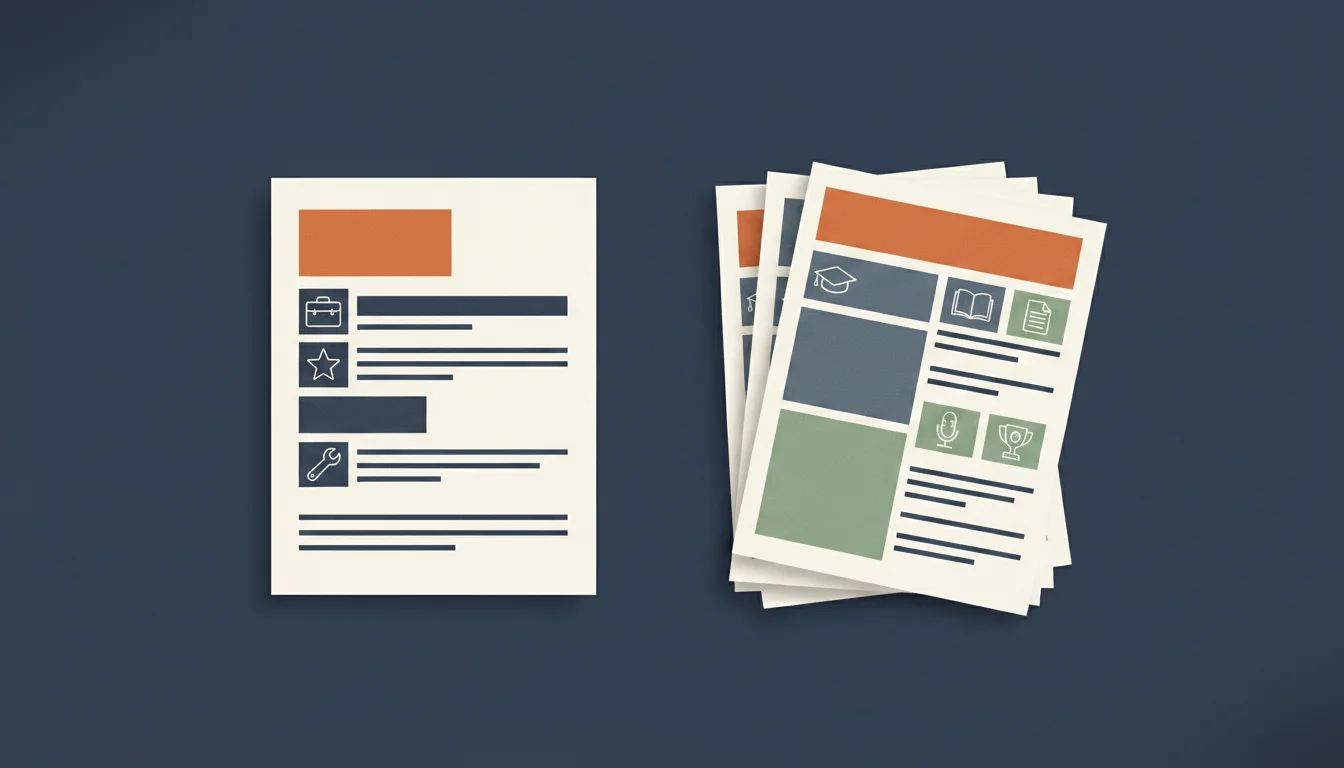
Here's the structural comparison most readers actually want — assuming the US-academic meaning of CV.
| Dimension | US résumé | US academic CV |
|---|---|---|
| Length | 1–2 pages | 2–10+ pages |
| Tailoring | Rewritten per application | Updated cumulatively over a career |
| Lead section | Work experience (experienced) or education (new grad) | Education, then publications, then research |
| Content scope | Work, skills, education | Publications, conference talks, grants, teaching, awards, service |
| Length trajectory | Capped — cut older content to stay under 2 pages | Grows — every publication stays |
| Photo | Strongly discouraged | Strongly discouraged |
| Reading time | Roughly 7 seconds on first pass | Minutes to hours for hiring committees |
The deepest difference isn't length — it's philosophy. A résumé is a one-page argument for why you should get this specific interview. An academic CV is a complete professional record meant for peer review, tenure committees, and grant reviewers who need the full ledger.
A 2018 Ladders eye-tracking study found recruiters spend an average of 7.4 seconds on an initial résumé scan before deciding whether to keep reading. The study's sample was only 30 recruiters, and later studies have measured slightly longer times, but the order of magnitude is what matters: seconds, not minutes. That's why the résumé ruthlessly summarizes and the CV exhaustively catalogs. For more on optimizing for that 7-second window, see how long your CV should be.
Which one should you send? A country-by-country guide
If you apply internationally, the routing table below is the entire game. Each row is a decision, not a suggestion.
United States, non-academic. Send a résumé. One page under 10 years of experience, two pages above. Even if the posting says "CV," send a résumé — the word is being used loosely. Photos off. Date of birth off. Marital status off.
United States, academic / research / medical / fellowship. Send an academic CV. Penn's career services describes it as a document that details all your academic credentials and professional accomplishments, used for seeking faculty jobs as well as postdoctoral research, grants, and fellowships. Length scales with your career — no one expects a senior PI's CV to fit on two pages.
UK, Ireland, Australia, New Zealand. Send a 1–2 page document and call it a CV. Structurally it's the US résumé: reverse-chronological work history, tailored per role. Photos off in the UK and Ireland; conventions are looser in Australia but photo-free is still the safer default.
Germany. Send a Lebenslauf. Most Germans still include at least their birthday and place of birth in their CV, and it is still very common for applicants to include a headshot. The University of Hohenheim's template lists first and last name, address, phone, email, date of birth, place of birth, LinkedIn profile, and a professional application photo as recommended. Photos are legally optional under anti-discrimination law, but culturally expected. See the German Lebenslauf guide for the full convention.
Finland. Send an ansioluettelo. InfoFinland, the government resource for foreign residents, notes you can also include a photograph of yourself — photos are optional but accepted. Exception: researcher CVs for the Research Council of Finland explicitly prohibit images or photographs in the CV to ensure the equal treatment of applicants. Know your context.
France, Spain, Netherlands. Call it a CV (or Curriculum Vitae / Currículum Vítae). Photo conventions vary — see CV photo conventions across Europe.
Canada. Same rules as the US: résumé for non-academic, academic CV for university and research roles.
The mistake most job seekers make
The failure mode is always the same: sending the right content under the wrong conventions.
An American applying to a UK job often sends a one-page résumé and calls it a résumé. The content is fine. The vocabulary reads as unfamiliar with the market, and the one-page length feels thin next to the UK-standard two pages. The fix is vocabulary plus a modest expansion: call it a CV, add a personal profile at the top, expand bullet content to fill the second page without padding.
A European applying to a US non-academic role often sends a three-page "CV" complete with photo, date of birth, place of birth, and a signature at the bottom. In the US, this is not merely overdressed — it's actively rejected in some pipelines. The EEOC explicitly recommends that employers should not ask for a photograph of an applicant, and many US recruiters are trained to discard resumes with photos to reduce discrimination-claim exposure. Date of birth triggers the same reflex. Strip all of it out.
The deeper point: the fix is never translating the word. Changing "Lebenslauf" to "Resume" on the top of your document without changing what's under it still sends a German document with a US label. Reformat to the destination's conventions — length, sections, personal data, photo — then use the destination's vocabulary.
If you're unsure which document your application needs, upload what you have to cvmakeover.ai and the review will flag the format mismatch against the target role and country before you send it.
Is a CV the same as a résumé?+
In the UK, Ireland, Australia, New Zealand, and most of Europe — yes. "CV" is the default word for the short, 1–2 page job-application document that Americans call a résumé. In the US, they are different: a CV is a long-form academic document and a résumé is the short job-application document.
Can I use the same document for a CV and a résumé?+
If you're applying to a US non-academic job and a UK non-academic job, yes — the content is essentially identical. Change the label at the top and adjust length expectations (1 page for US, 2 pages for UK). If you're switching between a US non-academic résumé and a US academic CV, no — they are different documents with different content.
Should I put a photo on my résumé or CV?+
Photo-free for the US, Canada, UK, Ireland, and Australia. Photo-conventional for Germany and France. Photo-optional for Finland (required-off for Finnish research council applications). Spain and the Netherlands vary.
What if a job posting asks for "CV/résumé"?+
The slash means the poster doesn't know the distinction or is hedging for an international audience. Send what the role actually wants: résumé for non-academic, academic CV for academic. The label is the same either way.
Key takeaways
- The CV vs résumé distinction is geographic, not structural: "CV" means a long academic document in the US and a short job-application document everywhere else in the English-speaking world.
- In the US, send a résumé for non-academic roles (1–2 pages) and an academic CV for university, research, medical, and fellowship roles (2–10+ pages).
- In the UK, Ireland, Australia, New Zealand, and most of Europe, "CV" is the universal term for a 1–2 page job-application document — "résumé" barely appears in postings.
- German Lebensläufe and French Curriculum Vitae conventionally include a photo and personal data; US and UK conventions strip both out for anti-discrimination reasons.
- When a US posting uses "CV" for a non-academic role, it almost always means résumé — the word is being used loosely, and sending a 5-page academic document is a miscalibration.
- The fix for cross-border applications is never translating the word — it's reformatting the document to the destination's conventions before relabeling.